About Pix
Pix is a payment method created and regulated by the Central Bank of Brazil (BCB). A Pix transaction can be carried out at any time, from Monday to Monday, and takes just a few seconds to complete.
In the Instant Payment System (SPI), transactions are carried out using “Pix Keys”, which function as a “nickname” for the account. So, when making a Pix, the system identifies the recipient’s account information from this nickname.
Pix Features
Benefits
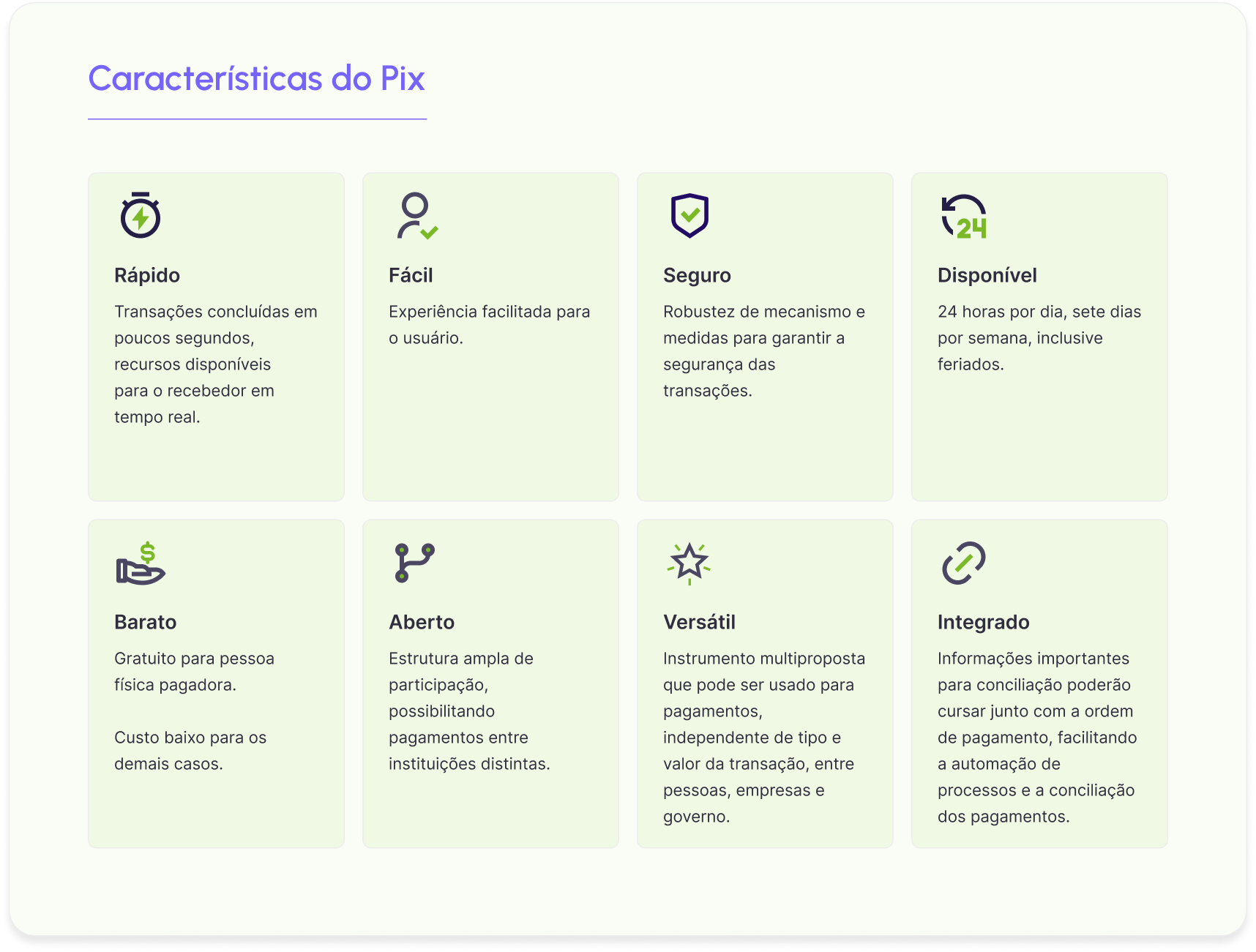
Pix was designed to be a broad payment method, that is, any payment or transfer that is currently made using different methods (TED, DOC, card, bank slip, etc.) can be made using Pix.
These are the main advantages of Pix, compared to other systems:
- It is not necessary to know the recipient's account details, as the account will have a “nickname”;
- There is no time limit or day of the week limit;
- Resources are made available to the recipient within seconds;
- Transactions can be initiated directly from your mobile phone.
DICT and Pix Keys
Each registered key identifies an instant payment account and can be of the following types:
- National registration (CPF or CNPJ);
- Email address;
- Cell phone number;
- Random key, also called EVP (Virtual Payment Address), a random code generated by the Central Bank.
All data linked to the key is stored in the Transactional Account Identifiers Directory (DICT), and the DICT API makes this directory available for searching — both created and maintained by the Central Bank of Brazil.
Each individual account can have up to 5 linked keys, regardless of the number of account holders. In the case of legal entities, the maximum is 20 keys per account. In our test environments, key queries are available on weekdays (not on weekends). During the week, the testing window starts at 6:00 a.m. and ends at 10:00 p.m.
ATTENTION: it is possible to register more than one key for the same account, but never the same key for different accounts.
BR Code
It is the name of the QR Code standard, for payment initiation purposes, adopted in Brazil, under Circular No. 3,682, of November 4, 2013. A QR Code is a two-dimensional graphic standard for encoding data that can be captured by image by electronic devices, such as mobile device cameras or readers at points of sale, allowing the automated entry of data into applications or processing systems. The QR Code is internationally standardized in the document ISO/IEC 18004.
Within the scope of the SPB, the representation of structured payment data (payer and recipient information, in addition to payment transaction details, which are graphically encoded in a QR Code) proposed in the EMV®1 standard for QR Codes for Payment Systems (QR Code Specification for Payment Systems) is adopted. This is an open and free standard, extensible, implemented in ecosystems in other countries, which meets the requirements of the Brazilian system with the potential for integration of existing arrangements, favoring the adoption, reuse and optimization of resources.
User Experience
One of Pix's goals is to ensure a simple and intuitive experience for the end user. To this end, the Central Bank established user interface criteria (payer and recipient), defined as Minimum Requirements for User Experience, which contains obligations and recommendations for each use case, addressing the following topics:
- Pix with Pix key
- Pix with manual entry of transactional account data
- Static QR Code Generation
- Payment via static QR Code
- Extract
- Return
- My Keys
- My Pix Limits
- Immediate or due payment via dynamic QR Code
- Scheduled Pix
- Pix Copia e Cola
- Pix Withdrawal and Pix Change
- Payment transaction initiation services on Pix
- Pix in Internet Banking
- Accessibility in Pix
Operational Limits
As established in BCB Normative Instruction No. 160/2021, maximum value limits must be established per transaction and per period (daytime/nighttime) for Pix transactions. For individuals, including MEIs, there is a nighttime limit pre-established by BACEN. The user may request an increase in these limits, but this operation will be carried out 24 to 48 hours after the request.
For our partners and customers who integrate with our APIs, there is an operational limit per transaction and per day. These values can also be adjusted via the support channel (support link) and also follow the same rule that it will only be effective 24 to 48 hours after the request. It is also possible to make this request via the Customer Panel.
In addition, users must be offered functionality that allows them to customize the start time of the night shift, to register accounts with specific limits and to manage general and specific limits for Pix Saque and Pix Troco. The obligations and recommendations for implementing this functionality are in BCB Normative Instruction No. 160/2021 and in the Minimum Requirements for User Experience document.
Security
Pix security is based on four dimensions:
I. User authentication
Every Pix transaction can only be initiated in a secure environment that is accessed using a password or other security devices integrated into the cell phone.
II. Transaction traceability
Pix transactions are 100% traceable, enabling the identification of accounts involved in transactions, allowing for more incisive action.
III. Secure information traffic
Information traffic is encrypted on the National Financial System Network (RSFN) and all Pix participants must issue security certificates to be able to transact on it.
IV. Operating rules
The Pix regulation provides for numerous measures that mitigate the risk of fraud, such as:
- the prediction that Pix participants must be held responsible for fraud resulting from failures in their risk management mechanisms;
- protection mechanisms, by the BC and institutions, that prevent scanning of personal information related to the Pix key;
- the possibility of establishing maximum value limits, based on the risk profile of their clients, by institutions;
- the possibility for users themselves, through applications, to adjust the value limits established by institutions;
- differentiated maximum time for authorization of the transaction, by participating institutions, in cases of unusual transactions initiated by their customers with a high probability of being fraud;
- information center, shared with all participants, about Pix keys, account numbers and CPF/CNPJ that were involved in any fraudulent transaction;
- Dynamic QR Code generation allowed only for participants who send specific security certificates to the BCB; and
- mechanisms that facilitate the blocking and eventual return of resources in the event of fraud, such as precautionary blocking and the special return mechanism.
️ Attention
It is the partner's responsibility to strictly follow all regulations regarding Pix, made available by the Central Bank of Brazil, meeting the minimum security and user experience requirements, and ensuring the correct use of the Pix brand . Failure to comply with the Central Bank's requirements will result in contractual fines and penalties.